|
Summer 2009
The summer season is on and beautiful summer plants are blooming prettily in local nurseries all around the country. Check out the new varieties, bred to be tough, pest-free, and re-blooming, dazzling good news for gardens. Petunias have always been hard workers and the new Blue Velvet, Double Wave Petunia, has big, double flowers and deep green foliage. See it at www.wave-rave.com Free flowering, mounding Lantana Citrus Blend is stunning and a proven winner.
Tigereye, a bright yellow Rudbeckia has lots of blooms and is disease resistance, from Burpee. We all love bleeding hearts, and the latest Burning Hearts has deep rose-red flowers with blue-gray foliage. This plant is hardy to zone 3 and will be lovely in your garden! The new Celosia Caracas has brilliant purple flower spikes that bloom continuously for weeks. Campanulas have been a favorite in the home garden since grandma's time, and Sarastro is gorgeous with dark purple bells covering this mounding plant like none other. Hardy to zone 5 is good news.
Ask for these new delights at your local nursery or garden center. While you are looking, check out the other wonderful perennials and annuals in many colors, heights, and growing habits to enhance your garden. There are plants and shrubs that would love to go home with you! Soon the fragrant summer lilies will be in bloom and if you missed the planting, buy them potted. July 09
A Visual Punch to your Gardens June 2009
Are your lovely daylilies blooming? Mine are! Tall, a rich gold color, and with seemingly a zillion buds ready to bloom. I love them against the rosy-hued Aaron's Beard. I simply must make time to get over to the Amador Flower Farm! I want bright yellow daylilies, and deep burgundy ones, and brilliant crimson beauties too! Although garden centers are lively this time of year with so much in bloom, so much color and varieties, I always find myself looking for the unusual. I want the plant I read about in Horticulture, the flowers that graced the cover of Fine Gardening. I want something exciting, different, that will give a visual punch to my gardens.
Hellebore's litany of garden traits, evergreen, cold hardy, and pest resistance, sold me  along with their beauty. Known as the Lenten Rose, they love dappled light so I grow mine under our young Crepe Myrtle tree. In West Point, I grew them under a pine tree. Usually blooming in winter and early spring, they are hardy to 20 degrees below zero. And deer do not like them! That's a plus! Buy a plant already flowering as they take two to three years to bloom. I love the deep burgundy paired with the soft green shade. They are striking planted near white snowdrops that bloom around the same time, in early spring. Hellebores are elegant and bring under story excitement and color to evergreens like pines, and firs. The different strains are lovely, single petals, double rows, semi-double, bowl-shaped with round petals, and ruffled petals. One I really like is the spotting on a rose-colored petal so dense it almost melts into the rosy background. Gorgeous! Photo by Eva Dunn along with their beauty. Known as the Lenten Rose, they love dappled light so I grow mine under our young Crepe Myrtle tree. In West Point, I grew them under a pine tree. Usually blooming in winter and early spring, they are hardy to 20 degrees below zero. And deer do not like them! That's a plus! Buy a plant already flowering as they take two to three years to bloom. I love the deep burgundy paired with the soft green shade. They are striking planted near white snowdrops that bloom around the same time, in early spring. Hellebores are elegant and bring under story excitement and color to evergreens like pines, and firs. The different strains are lovely, single petals, double rows, semi-double, bowl-shaped with round petals, and ruffled petals. One I really like is the spotting on a rose-colored petal so dense it almost melts into the rosy background. Gorgeous! Photo by Eva Dunn
Hot, hot days gave way to rainy, overcast days in our first summer month, June. How confusing is that for our plants! Especially our heat-loving tomatoes that we just put into the ground, dutifully waiting til the ground was 'warm enough to sit on' as garden books advised. Hopefully it will not affect the plants too badly. There is nothing like a home-grown tomato! Farmer's Markets are beginning this month everywhere and soon you will be able to get great tasting tomatoes. If you want to grow your own, you really don't need a lot of room or tools. A large half barrel works well for not only cherry tomatoes, but old favorites like Brandywine and Early Girl, too.
 This year sass it up and try green striped tomatoes; yellow canary, small like sweet 100's; Yellow Pear, small pear-shaped sweet tomatoes; and Orange Pixie, all which will jazz up your salads, sauté's, and summer's grilled kebobs. Tim's daughter Chalia has corn already growing in her Imperial Beach garden! The flowers there are amazing, Bird of Paradise, hibiscus shrubs, and a trumpet plant, a gorgeous shrub! In the herb garden she grows Borage, a lovely perennial with fuzzy stems and dainty, Periwinkle blue flowers that taste like cucumber! Wonderful in a salad. The vibrant orange Trumpet vine (photo below) covers her patio and cascades down the sides, a show stopper! Plant something new in your garden this year, something that takes your breath away! Photo: Chalia's Trumpet Flower scrambles up to the roof, photo by Eva Dunn Back to Top This year sass it up and try green striped tomatoes; yellow canary, small like sweet 100's; Yellow Pear, small pear-shaped sweet tomatoes; and Orange Pixie, all which will jazz up your salads, sauté's, and summer's grilled kebobs. Tim's daughter Chalia has corn already growing in her Imperial Beach garden! The flowers there are amazing, Bird of Paradise, hibiscus shrubs, and a trumpet plant, a gorgeous shrub! In the herb garden she grows Borage, a lovely perennial with fuzzy stems and dainty, Periwinkle blue flowers that taste like cucumber! Wonderful in a salad. The vibrant orange Trumpet vine (photo below) covers her patio and cascades down the sides, a show stopper! Plant something new in your garden this year, something that takes your breath away! Photo: Chalia's Trumpet Flower scrambles up to the roof, photo by Eva Dunn Back to Top
Blooms Galore May 2009
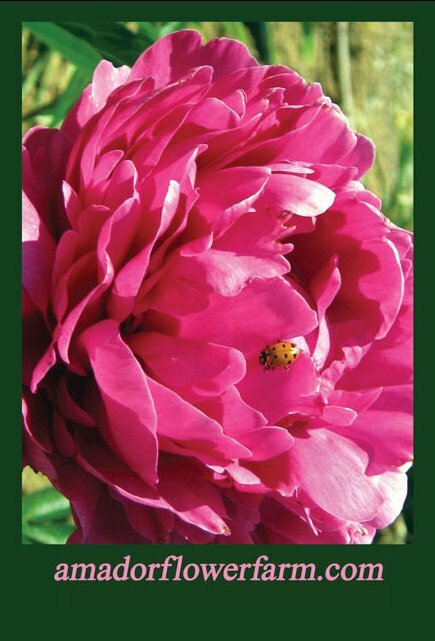
After some cold, rainy days May has finally brought us balmy winds and sunshine! Our gardens are blooming in happy profusion; I spy one lovely and am distracted by another just behind her, and the billowing, silky peonies are spectacular! They are worth waiting for, this one bloom time. Perfect, they resemble roses, but are larger, fuller, multi-petaled beauties. us balmy winds and sunshine! Our gardens are blooming in happy profusion; I spy one lovely and am distracted by another just behind her, and the billowing, silky peonies are spectacular! They are worth waiting for, this one bloom time. Perfect, they resemble roses, but are larger, fuller, multi-petaled beauties.
Iris stand tall and the soft, pastel colors complement the fresh green of my garden. I love lavender so I have deep, royal purple Iris, soft pale lavender colors, and tawny, peachy ones. Some are from my aunt Glorya's gardens who has since passed away, so they are special to me. She just loved the springtime! The Rhododendrons we brought from Oregon are blooming, so many lovely reddish-purple blooms and buds crowding the small plants. After their bloom time, they will be put into the ground, in afternoon shade, where they will get larger every year. These are cold hardy and reliable bloomers, resembling azaleas. Photo: Peonies in the Dunn Garden, photo by Eva Dunn
Springtime is a good time to get your hardscape ready for all the bloomers in your gardens. You can put in large pavers in-between the shrubs and plants, set out large decorative pots for accents, and even plant roses in some to set just there where the sun hits all day long. Design a mini-garden in a lovely pot, put in soil-less potting mix and timed-release fertilizer. Choose annuals with bright color, and greenery that will anchor the arrangement and make your creation look lovely. Make it full and lush, an instant garden!
 Remember your combination of colors in the gardens, like planting Lamb's Ears next to pink carnations which are planted next to Blue Fescue, a blue-grey grass that grows in tidy clumps. It throws up tall, arching spikes in the fall. A fragrant Don Juan climbing rose leans over and the whole effect is charming with a pop of color. Remember your combination of colors in the gardens, like planting Lamb's Ears next to pink carnations which are planted next to Blue Fescue, a blue-grey grass that grows in tidy clumps. It throws up tall, arching spikes in the fall. A fragrant Don Juan climbing rose leans over and the whole effect is charming with a pop of color.
There is this gorgeous, big blossomed, heritage, soft pink climbing rose in between the two tin walls of our shed and garage in Sutter Creek that is blooming now, and she is spectacular! She blooms early but has so many blossoms that she is in bloom for weeks! Reliable year after year, she sleeps through our occasional snow without a problem. Photo by Tim Dunn
 Our fragrant wisteria just finished blooming; a fantastic white Clematis tree with hundreds of blossoms was amazing, and now our Aaron's Beard is blooming, russet and white. It is so nice when for every month of each season, something wonderful is in bloom! Select plants to fall lazily along your pathways. There are so many annuals you can pick up at your local garden center that will bring delight to your gardens, and joy to your heart as you look out and see the lovely landscape that is your home. Be sure to remember shade and fruit trees, wonderful additions to the home garden. Still time to get those in the ground, ready for a summer harvest or summer shade. Photo: a 4yr-old Wisteria blooms profusely, by Eva Dunn Select one that will work double duty for you, bringing either amazing fruit in summer, or fall color to your yard, even lovely limbs in the winter. Evergreen trees too will be a good backdrop for winter season. Have fun in the garden! Back to Top Our fragrant wisteria just finished blooming; a fantastic white Clematis tree with hundreds of blossoms was amazing, and now our Aaron's Beard is blooming, russet and white. It is so nice when for every month of each season, something wonderful is in bloom! Select plants to fall lazily along your pathways. There are so many annuals you can pick up at your local garden center that will bring delight to your gardens, and joy to your heart as you look out and see the lovely landscape that is your home. Be sure to remember shade and fruit trees, wonderful additions to the home garden. Still time to get those in the ground, ready for a summer harvest or summer shade. Photo: a 4yr-old Wisteria blooms profusely, by Eva Dunn Select one that will work double duty for you, bringing either amazing fruit in summer, or fall color to your yard, even lovely limbs in the winter. Evergreen trees too will be a good backdrop for winter season. Have fun in the garden! Back to Top
A Gardener's Dream April 2009
These past two weeks have been a gardener's dream! Lovely weather, sunny with blue skies, yet not too hot, for some real work in the garden. It is planting time! Garden shops and nurseries are a blaze of color with hundreds of selections along with shiny new pruners, trellises, copper edging, sparkly wind-chimes, and huge, cobalt blue planting urns for the porch.
Oh, don't forget to go to the Amador Flower Farm for your daylilies...over 85 varieties of tall and short beauties in a myriad of colors. Mike Spinetta says to be sure to check out Steiner Road in Shenandoah Valley; it is ablaze in glorious Narcissus! Now, some great news...one of your neighbors has created an award-winning video on wildflowers! Here is the story sent to the 'Good News' paper!
Video on Mid-Sierra wildflowers wins accolades
 A wife’s desire to showcase her husband’s wildflower photography has resulted in an award-winning documentary high-lighting wildflowers of Calaveras and other foothill counties. "Al Lockwood, Photographing Wildflowers of the Mid-Sierra," is a 19-minute DVD. Crafted by his writer-wife, Sunny Lockwood, and Calaveras County videographer Larry Vile, "Wildflowers" reveals in gallery-quality fine art images with the stunning color and grace of more than 50 regional wild-flowers. A wife’s desire to showcase her husband’s wildflower photography has resulted in an award-winning documentary high-lighting wildflowers of Calaveras and other foothill counties. "Al Lockwood, Photographing Wildflowers of the Mid-Sierra," is a 19-minute DVD. Crafted by his writer-wife, Sunny Lockwood, and Calaveras County videographer Larry Vile, "Wildflowers" reveals in gallery-quality fine art images with the stunning color and grace of more than 50 regional wild-flowers.
Lockwood’s images have hung in the Prestidge Gallery in downtown Angels Camp, as well as other galleries in  the foothills and in the San Francisco Bay Area. When the Calaveras Public Access TV studio announced a "Best Video Contest" last year, Sunny, who works part-time at the studio, decided it was time to pull together her husband’s photo art and create a DVD that revealed the beauty of the flowers and Al’s approach to photography. She wrote a script, got Al to select about 60 slides from his library of 5,000 images and, working closely with Larry Vile, produced a video to enter in the contest. In January her effort paid off when "Al Lockwood, Photographing Wildflowers of the Mid-Sierra" won third place in the Best Video Contest. The DVD is available at Prestidge Gallery and The Aeolian Harp in down-town Angels Camp, Danielle's Hair Design in West Point and at the Calaveras Arts Council Gallery in San Andreas. April 2009 the foothills and in the San Francisco Bay Area. When the Calaveras Public Access TV studio announced a "Best Video Contest" last year, Sunny, who works part-time at the studio, decided it was time to pull together her husband’s photo art and create a DVD that revealed the beauty of the flowers and Al’s approach to photography. She wrote a script, got Al to select about 60 slides from his library of 5,000 images and, working closely with Larry Vile, produced a video to enter in the contest. In January her effort paid off when "Al Lockwood, Photographing Wildflowers of the Mid-Sierra" won third place in the Best Video Contest. The DVD is available at Prestidge Gallery and The Aeolian Harp in down-town Angels Camp, Danielle's Hair Design in West Point and at the Calaveras Arts Council Gallery in San Andreas. April 2009
Back to Top
Planning your 2009 Summer Garden March 2009
Spring is right around the corner and the weather has been absolutely gorgeous. The lovely and hardy Narcissus have been blooming since February suns warmed their bulbs into bursting into bloom. Sweet smelling with tiny, white blooms, they promise spring way before it arrives.
Now is the time to finish planning your 2009 garden. If you are doing a vegetable garden, I know you are getting excited at the thought of all the heirloom tomatoes you have envisioned for this year's harvest. Luscious, ripe tomatoes dripping from vines, laying across the raised planters they share with the peppers and squash. Homegrown beauties more flavorful than the next. You can almost taste them in salads, soups, sandwiches, grilled and roasted. Ah, summer!
Choose different colors, gold's, yellow's, pale green's, bright red's, to delight the salad lovers in your family. Select huge beefsteak and Brandywine tomatoes for amazing sandwiches and vegetable platters. Try Sun Gold, White Queen, Sweet 100, Basil, Stuffer, Peach, and Persimmon varieties for some excellent heirlooms! Again, if you have little room to garden, or that wretched clay soil, use containers. Potted plants, whether they are vegetables or flowers, make moveable containers and give your landscape an interesting, colorful lift. Plant your patio tomatoes in an old bucket or tub right outside your back door for fresh-picked delights. Remember to include a stake.
Have an old, enamel tea kettle, or a dipper? Plant them with basil, or lemon balm, charming, useful, and tasty! Even an old chicken feeder can enjoy a second life as a planter, with perky pansies planted all in a row to bring happy smiles. Find old wooden or metal chairs at garage sales and paint them with vivid colors, pick cheerful fabrics for outdoor cushions. Place them near dazzling, bright colored flowers. There are no hard rules to creating a garden space for your spring and summer living; make it your own with knickknacks to add colorful spots of your personality. Put broken china pieces or tiles in between your pansies, or enhancing your iris beds. Favorite china or glass will live on in the garden, making it unique.
Garden lights need not cost money if you use favorite ceramic or china cups that are cracked. Place candles inside and see how they light up the evenings. Have collections taking up space and collecting dust? Find a special place in the garden to show them off. Collect a lovely bouquet from your gardens and display them in a favorite urn, or tall pot. Keep just a little water inside, place them near a chair, by the front door, or on the lawn next to the mailbox for a lovely scene.
 Your garden is your retreat, your relaxation place created for your style, your function. It can be fancy or simple; a series of rooms that unfold, providing deep pleasure for all who enter. Make the seating comfortable, the views stunning, the paths whimsical, the mix colorful, and you will not go wrong. This is a place you will want to be all year long. Your garden. Your garden is your retreat, your relaxation place created for your style, your function. It can be fancy or simple; a series of rooms that unfold, providing deep pleasure for all who enter. Make the seating comfortable, the views stunning, the paths whimsical, the mix colorful, and you will not go wrong. This is a place you will want to be all year long. Your garden.
Photo: Blooming now, Spring Daphne, photo by Eva Dunn
Back to Top
Lively winter landscapes February 2009
Most people think of winter as a garden's downtime; it is work-wise, but the best gardens look beautiful year-round, even in snow. What makes it beautiful? Structure, texture, color and some hardy species that work hard all year. Choose plants with berries, bark, foliage, twisted or colorful branches, and flowers that stand up to winter in a lovely way. With a little thought, planning, and careful selections, you can create a fantastic winter wonderland right in your backyard.
Shrubs like Azalea, Oakleaf Hydrangea, Japanese skimmia, Japanese Andromeda; trees like Hawthorn, False Cypress, Witch Hazel or Paperbark Maple are striking; choose ground-covers like Fountain Grass, Heather, Black-eyed Susan, Lungwort, Juniper, or Stone-crop. Rhododendrons and Azaleas are perfect for winter gardens for although they stop blooming, their leaves don't drop and are a pleasing, evergreen sight. Patio peach tree sheds its foliage to reveal knotty black trunks, and the peeling bark of the River Birch gives it a shaggy appearance. Purple winterberry is lovely, its almost porcelain-looking berries gracing its branches, and the white berries of the Snowball shrub are a delight, fall through winter.
 Because gardens in spring and summer have foliage to fill them out, the winter garden will benefit from evergreens for background and structure appeal. A Blue Spruce would be lovely, as would a golden Japanese red pine. Weeping Willows, the arching Katsura tree, and the contorted Beech with its corkscrew limbs are interesting in the garden when all else sleeps. It is still a good time to get those spring and summer bulbs in the ground. Welcoming sunny days and blue skies still are on our horizon, although we did have some rain a few days ago, and are expecting more in the coming weeks. If you did not get around to pruning your roses, or finishing the garden cleanup, you still have time. Because gardens in spring and summer have foliage to fill them out, the winter garden will benefit from evergreens for background and structure appeal. A Blue Spruce would be lovely, as would a golden Japanese red pine. Weeping Willows, the arching Katsura tree, and the contorted Beech with its corkscrew limbs are interesting in the garden when all else sleeps. It is still a good time to get those spring and summer bulbs in the ground. Welcoming sunny days and blue skies still are on our horizon, although we did have some rain a few days ago, and are expecting more in the coming weeks. If you did not get around to pruning your roses, or finishing the garden cleanup, you still have time.
Photo: Four season interest with Pyracantha, photo by Eva Dunn
It's a perfect time to create new garden pathways. Dig out shallow depressions in your desired paths through your garden. Snuggle in stones or bricks, fill in around them with sand. Tamp the sand firmly with a sturdy 4x4, a stout log, or a metal tamper. Sweep away the excess, dampen down the area with a hose, and your path is done. If placing flat stones in a grass path, be sure the ground is flat, and use flagstone, or bluestone. I planted creeping Thyme in-between the stone pathways in my garden. They fill in nicely and give off a pleasing fragrance when stepped upon.
Brighten your winter landscapes with portable bowls of c olor filled with pansies, petunias, and cyclamen. Select trailing plants that fall over the edges, either flowering, or green ivy. Small clumps of Asters will bloom through icy weather and stand taller than the other plants, creating a balanced look. Gardens are like a beautiful canvas, a work in progress. You can add and change things to reflect your personal taste. You may want a country garden filled with color and beautiful scents. You may want a garden for serenity and privacy, including a tall fence. You might have dogs, needing tough garden plants that are not easily crushed. Children may require a garden with low maintenance needs, a play area that is safe, and a family recreation spot, like a porch, patio, or fire pit area. Wisteria, roses, daisies, Jasmine, shrubs are only a few of the hundreds of selections to customize your garden. Enjoy planning your unique garden! Photo: Snowball is a stunning early spring blooming shrub, its blossoms going from small, green globes to fully opened, fluffy white ones. Photo by Eva Dunn olor filled with pansies, petunias, and cyclamen. Select trailing plants that fall over the edges, either flowering, or green ivy. Small clumps of Asters will bloom through icy weather and stand taller than the other plants, creating a balanced look. Gardens are like a beautiful canvas, a work in progress. You can add and change things to reflect your personal taste. You may want a country garden filled with color and beautiful scents. You may want a garden for serenity and privacy, including a tall fence. You might have dogs, needing tough garden plants that are not easily crushed. Children may require a garden with low maintenance needs, a play area that is safe, and a family recreation spot, like a porch, patio, or fire pit area. Wisteria, roses, daisies, Jasmine, shrubs are only a few of the hundreds of selections to customize your garden. Enjoy planning your unique garden! Photo: Snowball is a stunning early spring blooming shrub, its blossoms going from small, green globes to fully opened, fluffy white ones. Photo by Eva Dunn
Back to Top
Time for Bareroot
 Winter January 2009, has been tame these past few weeks, with fog in the mornings fading to blue skies and sunshine. Narcissus are blooming and they smell heavenly! What a wonderful surprise to see in an icy cold garden landscape each morning. Thank goodness we all mulched our plants, otherwise the resulting heaving of the ground could pop those plants right out of the ground! It's time to plant Bareroot and most nurseries are busy with sales; the choices are amazing. So many beautiful colors, varieties and scents; there is something for everyone. Winter January 2009, has been tame these past few weeks, with fog in the mornings fading to blue skies and sunshine. Narcissus are blooming and they smell heavenly! What a wonderful surprise to see in an icy cold garden landscape each morning. Thank goodness we all mulched our plants, otherwise the resulting heaving of the ground could pop those plants right out of the ground! It's time to plant Bareroot and most nurseries are busy with sales; the choices are amazing. So many beautiful colors, varieties and scents; there is something for everyone.
Tim surprised me with a Rugosa rose for New Year's, its stems studded with thorns, a promise of disease-free, lovely scented blooms in summer. The next week as a Saturday gift, he brought home a winter Daphne, the most incredibly scented evergreen shrub. They bloom in early spring when the daffodils bloom. I love these plants! Both were purchased at the Ridge Road Garden Nursery in Pine Grove; they have great plant selections. In Burson, the Rising Sun Nursery has a bounty of bareroot also; they also have classes coming up to help you do a great pruning job on roses and fruit trees. Rosarians in the McKinley Park Rose Garden in Sacramento have already begun pruning. They have hundreds to do; Tim only has about twelve; that should make him happy. Pruning promotes a beautiful show of flowers all summer long. Photo: early Narcissus in the garden are fragrant beauties, by Eva Dunn
Remember to spray for Peach Leaf Curl before it rains; plant bareroot fruit trees, berries, grapes and asparagus now. Lots to do before the wet, cold months storm in. Now is the time to buy 'bling' for the garden, great containers that invite, for succulents, trailing plants, for collections of colorful interest plants that are portable.
Back to Top
Visit the columnist's garden sites at:
www.dunnfarm.com
www.ovrthegardengate.com
www.ridgeroadgardencenter.com
|