Star Trek Into Darkness in IMAX 3-D
A Review by Ken Kiunke
Staff Writer
 J.J. Abrams' latest action packed Star Trek film is now playing in IMAX 3-D at the Esquire IMAX theater in downtown Sacramento. This is Abrams' second voyage into Trek territory, after he tackled the “original prequel” to the iconic television and film franchise. Of course the latest twist is that he is set to direct at least the first of the new Star Wars films, which places him squarely on the fence between the Trekker vs. Jedi camps. Abrams' 2009 Star Trek, written by Roberto Orci and Alex Kurtzman, used the device of a parallel or alternate universe reality to free the story from being a “pure” prequel, which allows them to carry the characters in directions that don't exactly follow the storyline already established.
 So, for example, while Spock's human mother Amanda, as played by Jane Wyatt, was featured in the TV series, she won't exist in the new reality, as she was killed when the planet Vulcan was destroyed in the first prequel film. However, the writers for future Star Trek films will be free to guide the stories without having to line up exactly with the show. That said, the new film is an entirely enjoyable mix of action and psychological thriller, which pits Captain Kirk (Chris Pine) and Spock (Zachary Quinto) and the familiar crew against a couple of formidable new enemies, including John Harrison, played by Benedict Cumberland. Photo: Zachary Quinto and Chris Pine
 As you may expect, telling the difference between friend and enemy can be puzzling in the Star Trek world, as it sometimes is in the real world. After an early scene, you may start to figure out why the Klingons have been so ticked off at the Federation for so long. I won't give up any secrets here, but suffice to say the friends and enemies list keeps shifting, with some real surprises that will resonate with Star Trek fans. It is no surprise after the 2009 film how well the new cast fits into their roles, an especially challenging task given the iconographic characters established in the TV series and six films starring William Shatner and Leonard Nimoy. But this film shows again how well Pine inhabits Kirk, while also making him something of his own, and Quinto could really be mistaken for a young Nimoy. Photo: Zachary Quinto
 Karl Urban is also spot on as Dr. McCoy, though perhaps a bit less melodramatic than Deforest Kelly played him. But Zoe Saldana, other than being an attractive black woman, doesn't really have much in common with the original Uhura as played by Nichelle Nichols, and she takes a much bigger role in this story. But the idea that she and Spock have a romantic attachment is a bit odd; since it is several years away from his next “pon farr” episode, what need does he have of a girlfriend? Illogical. I guess it is his human side coming out. In any case, Uhura becomes much more of an action figure in this film, rather than just a smart, caring woman with great legs. Photo: Zoe Saldana as Uhura
As far as the rest of the main cast goes, Simon Pegg has a Scottish accent like James Doohan (Mr. Scott), John Cho is Asian like George Takei (Mr. Sulu), and Anton Yelchin has a Russian accent like Walter Koenig (Ensign Chekov) - but there the resemblance ends. None match the personalities of the originals, but each does a fine job in the character he plays. Pegg brings some real frantic energy to the young Montgomery Scott that we never saw from Doohan, who was somewhat more stoic (but no less entertaining a character.) Of course, Takei's Sulu was mostly even-keeled and reliable in the early days, as Cho plays him here, but his feistiness came out much more in later episodes and in the films, especially as Takei began to bristle under the larger than life personality and ego of Shatner.
 Star Trek Into Darkness has several nods to fans of the original show. The appearance of a Tribble in something of a crucial “role” was a surprise. Fans will remember “The Trouble With Tribbles” as being one of the goofier, yet most appealing episodes. More subtly, the mention in passing of Christine Chapel, who was Dr. McCoy's head nurse in several episodes, won't be missed by Trekkers. In fact, when beautiful, blonde Alice Eve shows up as science officer Carol Wallace, I thought for a second Yeoman Rand had appeared. Photo: Christine Chapel
 While the film is firmly in the Star Trek mode of action and thought, a few of the sequences did echo some Star Wars scenes. The Spock in the volcano scene at the beginning was resonant of the scene in Star Wars - Revenge of the Sith, when Obi Wan and Anakin battle on the volcanic Mustafar. The later scene of Spock chasing Harrison on top of flying speeders was very much like the Star Wars - Attack of the Clones scene of Anakin and Obi Wan chasing the bounty hunter on Coruscant. And Kirk's piloting of the small ship into the Klingon planet was like innumerable similar Star Wars high speed ship chases and battles, and even reminded me of Disney's 3-D Captain EO.
Photo: Zachary Quinto
In fact, all the special effects involving action sequences owe something to George Lucas and his Industrial Light and Magic, which set off the rise in space science fiction effects used in countless other endeavors, such as Battlestar Gallactica, the Alien films, and the older Star Trek films and TV series. Of course, they were all no doubt inspired by Gene Roddenbery's original Star Trek series, despite its primitive, yet enjoyable visual effects. Who can forget the transporter effect, phasers, the rolling digital counters, and the still photos arrayed across the bridge walls. If we want to compare the two leading Sci-Fi film franchises, both of which are finding new life after a bit of dormancy, we can find why both are important to people for different reasons, and why true fans can love them both.
 First and most obviously, Star Trek is about us – people of earth in the distant future, dealing with human issues involving how we deal with each other and foreigners (or alien life.) Star Wars is about a whole other civilization long ago and far away (though they mostly look a lot like us.) Their civilization has already connected the solar systems and formed relations and alliances with each other. Star Trek has always been based on exploration and learning about life and new civilizations – and the rules around that – the “Prime Directive” has been a part of Star Trek since the beginning. Star Wars is about politics – conflict arises over trade arrangements and legislative battles, and results in galaxy wide power struggles.
Star Trek is about reality (sort of). The people are people, and have no powers beyond their physical, technological and psychological limitations. Klingons are tough, Romulans calculating, Vulcans logical, and humans relationship based. Star Wars is spiritual, and those in tune can tap into the “Force”; whether for good or evil, it guides the user to superior skills and can triumph over weaker minds and physical reality (Trek strays a bit into this territory for Vulcans, with their mind melds and neck pinches, but it is limited). So Star Wars builds its fables around the good (Jedi) versus the evil (Sith) and all those around trying to leverage their own advantages within the conflict. Star Trek is built around basically good but flawed people exploring the galaxy and trying to get along with the other races they encounter as they expand their universe, all while trying to keep their own human (or Klingon, or Romulan...) impulses in check.
 So after something of a Star Wars domination for a while, Star Trek is back in front with the two newest films, while Star Wars is regrouping after Lucas dropped out of the process. And seeing this new film in IMAX and 3-D makes it a totally immersive experience. The screen fills the entire wall, and with enhanced stadium seating, the images are complete within your normal field of vision. Plus the resolution is crystal clear, and a step up from regular 3-D. Add the surround sound and you can get lost in this compelling film. The images and story are intense, and not suitable for the youngest viewers.
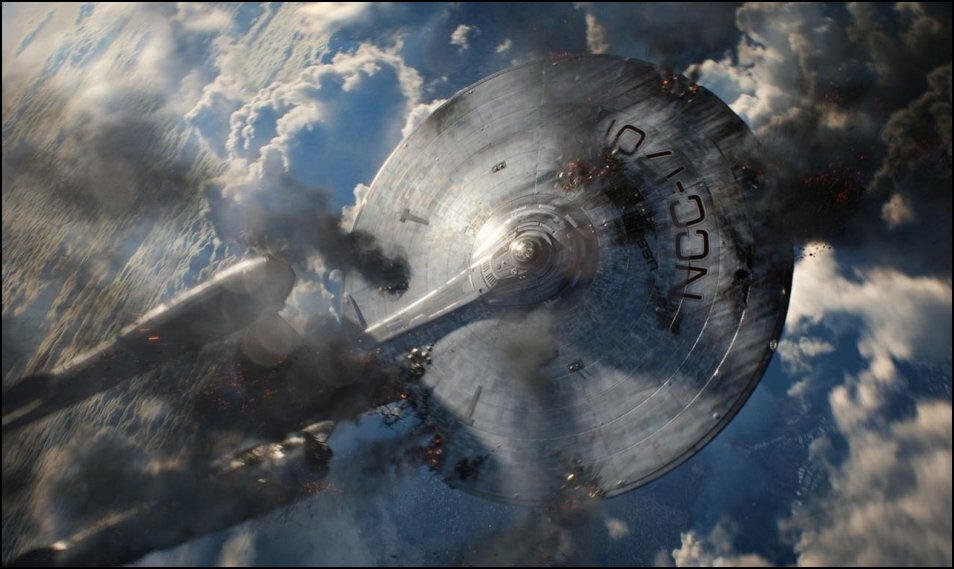
There is one somewhat troubling sequence. At one point, a starship crashes into earth, at San Francisco Bay. After obliterating Alcatraz (which had by then stood for hundreds of years!) the ship proceeds into the city, obliterating several skyscrapers and glass buildings. It is a spectacular effect, but the scene that follows is just a “get-the-bad-guy” chase, and the people around don't seem to realize the devastation that just hit a big part of the city. Post 9/11, we know the effects of this, which would have included tens of thousands of lives, and a major environmental impact. And yet the trolley cars are still running, and people are going about their everyday business as Spock chases Harrison. Are the people of the 23rd century so jaded to major events like this that it is just another day? It is rated PG-13 for violence and some language, but probably fine for mature 10 to 12 year-olds. Photo: Star Trek Into Darkness
Star Trek Into Darkness is currently playing at the Esquire IMAX theater in downtown Sacramento 1211 K Street (adjacent to the Convention Center.) For information and show times, see www.imax.com/oo/esquire-imax/ The Man of Steel 3D will have an advance screening Thursday, June 13... tickets on sale now. For more information about the Esquire IMAX, upcoming events, or to get tickets, go to www.imax.com or call the box office at (916) 443-4629.
Enjoy the IMAX experience soon. Free parking is at the Capitol Lot on L & 10th Streets, weekdays after 5pm, and all weekend with validation sticker. Present your parking ticket at the Box Office. For birthday parties and field trips, aatilano@imax.com or phone: 916-446-2333x200. For events, fundraisers, IMAX educators and private show screenings, email wrussell@imax.com or phone 916-446-2333 x201.
Back to Top