Exploring Gold Country - "Real travel is travel that moves along the land"
By Mel C. Thompson
Guest Writer
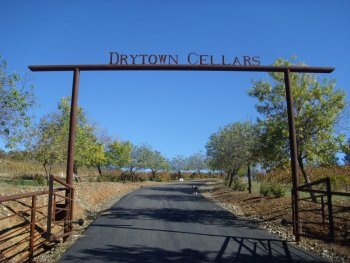 Since the late 1970s, I've been an avid bus and train rider, exploring every inch of California that I could get to. I'm a big lover of mass transit and have only owned cars a small portion of my life. My goal has been not merely to find a suitable commute to work, or a good train to Los Angeles, but rather to see how far one could go by mass transit. And while I've been a big-city person, born in LA County and spending a lot of my life in SF County, I was always more curious how far out into the country one could go without using a car or a plane. Photo by Mel C. Thompson: Drytown Cellars
Even in Europe, I have never flown from one country to another, but insist on taking ferries, trains and buses everywhere once the plane lands. Real travel is travel that moves along the land. Car drivers are often too busy piloting their vehicles and listening to the radio to notice much about even their own home towns. And this all fits into my great passion for walking. I had lately come to feel that I had exhausted just about every bus route, BART stop, Cal-Train and Amtrak destination available to me.
Being a lover of Sacramento, I'd been there many times, and was eventually led to explore Folsom, Placerville, Auburn, Nevada City and the Tahoe Area in great detail, but, eventually, that well ran dry too. Then one day I noticed there was a "wine country" in the foothills just south of all the other counties I'd combed. I did not know its name, but finally realized it was called Amador. People told me there was no way to get there, and even the residents, two of whom I had correspondence with but had never visited, also were clueless as to how I might get there. At last I found the Amador Transit website and realized the magnitude of the difficulty. But I decided to face it. As it goes, the #1 bus goes from Sacramento to Amador only one time in the morning, 7:50AM. If one were to take a mass-transit day trip, this would involve me getting out of bed at 3AM to be at Lafayette BART by 4:30AM.
That train would take me to downtown Oakland, at 12th Street. From there, one faces a rather daunting urban walk in the dead of night through one of the most violent cities in the country. (Not for the faint-of-heart nor the inexperienced.) There one finds a 5:30AM train that is scheduled to arrive in Sacramento at 7:28AM. Here, any snag on the Amtrak would ruin the whole thing, because one has to go directly to the Holiday Inn and search for the Amador County bus stop. Bureaucratic problems between the two counties has resulted in their being no bus stop sign for the Amador Express. Hence, one wanders meekly about 3rd and J Streets in the cold Sacramento morning, asking people, "Is the stop here?" At last one or two Amador residents who had been seeing relatives in Sacramento appeared.
One can tell they are from Amador County. They are watchful, cautious, alert, themselves not knowing exactly where the bus will pull up this week. Seeing others as uncertain as I was, I approached them, and we all waited together. When the bus got me to the Amador Transit Center around 9AM, I began transferring to the shuttles and walking all over Jackson and Sutter Creek, taking pictures. The landscape struck me as more profoundly beautiful than the other foothill counties, due to its mix of lushness and minimalism. Some areas almost desert dry, while others almost forest-like in nature. There was something rather Zen about the starkness of the dark trees, thinly spread against golden, summer-blond meadows. I vowed to come back the next week. (One has to be able to go 24 hours without sleep to make this journey since there is only one late afternoon bus home, a layover in Sacramento, and then another walk through downtown train ride home.
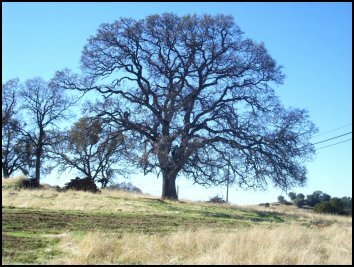 The next week I walked about ten miles. After the #1 bus dropped me off near Drytown, I walked to Plymouth, photographing the landscape and taking pictures of charming signs, abandoned shacks and beautiful mansions. It was all interesting to me. After walking back to Dry-town from Plymouth, I began photographing Drytown in some detail. I had heard that the neighborhoods of New Chicago and Bunker Hill had another kind of beauty unique to them. After a most delightful visit at Drytown Cellars, the very most intimate winery I've every seen, I headed out in the heat with two bottles of water and lots of room on my digital camera drive. Photo by Mel C. Thompson: The tree in Plymouth
The mining areas near the top of the hill around the intersection of New Chicago Road and Bunker Hill were most interesting. And so was Amador City. I would have spent more time photographing Amador City, but there was no bus between there and Sutter Creek, and time was running out before the last bus of the day left for Sacramento. After doing a bit of ride-begging around the village, a very nice couple soon volunteered to take me back to Sutter Creek where I could catch a bus home.
Most fascinating was the presence of the Miwok Tribe. Like almost everyone in Amador, they were unusually friendly to me. Whether at the Rosebud Diner in Jackson or the Old Well Café in Drytown, I have found Amador people very interested in stopping and sitting with me and telling me stories about how they came to this county, what they love about it, the hardships of life sometimes faced in rural areas and everyone knew a bit of history, which spiced it all up.
 One couple found me taking a picture of a well-shack located on their property. They told me how at one time all of Plymouth got their water from that one well. For now, my Amtrak points have run out, and I'll have to save a while to afford to come back. I next plan to visit Ione. My father, who lives in Tahoe part of the year, will next summer, probably be driving me to Volcano, Pioneer and many other hamlets around Amador. I may take some months off to regroup financially, but it is almost certain that me and my $99 Polaroid digital camera will be back until I've left no stone unturned in this most interesting new world for me. Photo by Mel C. Thompson: The New Chicago shack
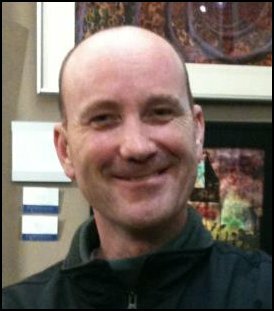 Semi-retired and living in Lafayette, California, I have appeared in many types of media, some only quite briefly, but have had the good fortune to have many of my writings and photos published in little magazines around the world, and occasionally made appearances in news stories as well as in USA Today or the LA Times. My only political statement will be that I wish Sacramento would grant Amador Transit the right to post a sign on one of the poles already situated there or to plant a pole of its own. It's an Amador pride thing. Photo: The Artist/Photographer Mel C. Thompson
Regarding the Plymouth Tree photograph: This photo seems almost psychedelic, and is emblematic of the light and color balance of your landscape. It seems amazing to me how the blue sky and the wild limbs of the tree, and perhaps the reflection off the golden fields, produced an almost "purple haze" aura around the tree. There is something in the combination of the land and sky there in Amador County that produces a kind of clarity of image that is seldom to be found elsewhere. What makes photography worthwhile is when a picture has perspective, tells a whole story, and implies much more than what lies in the field of view.
Back to Top